
USDA and FHA Manufactured Home Foundation Requirements: What Buyers Need to Know
By Keith Lopez Mortgage Loan Originator · NMLS #2814077 Reviewed by Keith Lopez
Quick answer
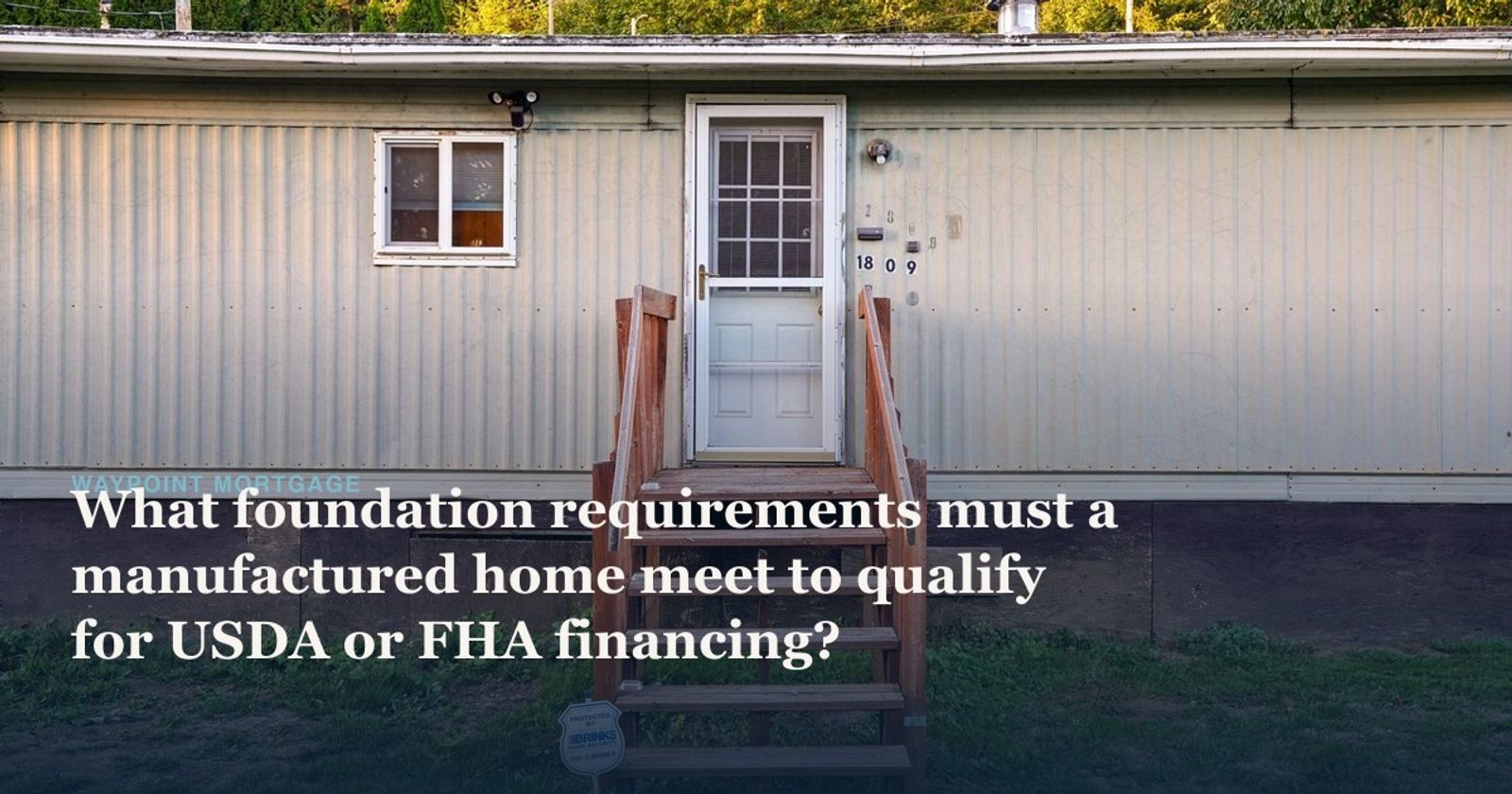
What foundation requirements must a manufactured home meet to qualify for USDA or FHA financing?
Both USDA and FHA require a manufactured home to sit on a permanent foundation that meets the HUD Permanent Foundations Guide for Manufactured Housing (PFGMH). A licensed engineer must certify the foundation in writing. The home must also be titled as real property, carry its HUD certification label (or an IBTS label verification letter), and, for USDA, a data plate or approved duplicate. USDA adds age and history limits: an existing home must be no more than 20 years old at closing and never installed on another homesite.
- The HUD Permanent Foundations Guide for Manufactured Housing (PFGMH, HUD-4930.2) is the governing document for both USDA and FHA foundation standards.
- A state-licensed engineer (or architect, for FHA) must certify the foundation before closing; FHA may accept a prior FHA certification if nothing has changed since.
- The home must be classified as real property by closing, with the vehicle-style title retired where state law allows.
- Both programs require the HUD certification label (the red tag) or an IBTS verification letter; USDA also requires the data plate or a duplicate.
- USDA finances new units and existing units up to 20 years old that were never moved from their original site; FHA has no age cap beyond the 1976 HUD code cutoff, but it also requires that the home was never moved from its original site.
- Missing tags, unpermitted additions, or a non-conforming foundation can delay or disqualify a loan, so identifying issues early matters.
Why Foundation Standards Exist for Manufactured Homes
Manufactured homes are built in a factory and transported to a site, which means the foundation they land on is installed separately from the home itself. Government-backed loan programs treat the foundation as a key safety and durability factor. If the foundation fails, the home can shift, utilities can be damaged, and the collateral value the lender is counting on can erode quickly.
HUD published the Permanent Foundations Guide for Manufactured Housing (commonly called the PFGMH or HUD-4930.2) to set a national baseline for what qualifies as a permanent foundation. Both USDA and FHA reference this guide in their handbooks. When a lender orders an appraisal on a manufactured home, the appraiser is expected to note whether the foundation appears to conform to PFGMH standards. Both programs require a foundation certification on every manufactured home loan, not just when the appraiser has doubts.
Keith Lopez (NMLS #2814077) at Waypoint Mortgage works with buyers across North Carolina, South Carolina, and Georgia who are exploring manufactured home financing. One of the first questions he asks is whether the home already has an engineer certification on file, because obtaining one after the purchase contract is signed can add time and cost to the transaction. Understanding the requirements before you make an offer puts you in a much stronger position. You can review the broader landscape of manufactured home loan programs at our loan options page before diving into the foundation specifics below.
What Does the PFGMH Actually Require?
The HUD Permanent Foundations Guide for Manufactured Housing describes several acceptable foundation systems, including perimeter wall foundations, slab-on-grade systems, and pier-and-beam configurations that meet specific load and anchorage criteria. The key word is permanent. A foundation qualifies as permanent when it is designed to remain in place for the life of the home, is connected to the home's structural frame, and transfers loads to the soil in a way that resists wind, seismic, and gravity forces appropriate for the site's geographic zone.
The guide requires that the foundation system prevent moisture from accumulating under the home, that the home be anchored against lateral and uplift forces, and that the crawl space or under-floor area be properly ventilated. In states like North Carolina, South Carolina, and Georgia, wind zone and frost depth considerations affect which specific foundation design is acceptable. A licensed professional engineer who is familiar with local soil conditions and building codes must evaluate the actual site, not just review a generic plan.
The engineer's certification letter must be site-specific. It should identify the property address, describe the foundation system observed, reference the PFGMH, and state that the foundation meets or exceeds the guide's requirements. A generic letter or one that references a different address will not satisfy underwriting. Lenders and underwriters typically require this level of specificity.
Real Property Titling: Why De-Titling the Home Matters
A manufactured home starts its life as personal property, titled much like a vehicle. To qualify for USDA or FHA financing, the home must be converted to real property and affixed permanently to the land. This process is sometimes called de-titling or retirement of the certificate of title. The exact steps vary by state, but in North Carolina, South Carolina, and Georgia, the process generally involves recording an affidavit of affixture or a similar document with the county recording office (the Register of Deeds in North Carolina and many South Carolina counties, the Clerk of Superior Court in Georgia) and retiring the title with the state agency that issued it.
The land and the home are normally owned together. In most cases the home and land are financed together as one real property; FHA allows leased land only when the lease meets HUD's leasehold requirements, and USDA only in narrow cases such as community land trusts. The deed must reflect both the land and the home as a single parcel of real estate. Lenders will verify this through the title search, and the closing attorney and title insurer will need to confirm that the de-titling was completed correctly before issuing a clear title commitment. North Carolina, South Carolina, and Georgia are all attorney-closing states (South Carolina requires attorney supervision), so the closing attorney will also review the real property conversion documents.
Buyers who are purchasing a manufactured home that was never properly de-titled should factor in the time and cost of completing that process. It is not always a quick fix, and in some cases it requires coordination between the seller, a title company, and the state agency that holds the original title. Identifying this issue during due diligence, rather than at the closing table, is critical.
HUD Certification Label and Data Plate: What They Are and Why They Cannot Be Missing
Every manufactured home built on or after June 15, 1976, is required by federal law to carry a HUD certification label, commonly called the HUD tag or red tag. This small metal plate is affixed to the exterior of each transportable section of the home. It certifies that the home was built to HUD's Manufactured Home Construction and Safety Standards (MHCSS). The appraiser checks for this label; if it is missing, an IBTS label verification letter can substitute.
The data plate is a separate document, typically a paper label affixed inside the home, often in a kitchen cabinet, electrical panel, or bedroom closet. It contains information about the home's design specifications, including the wind zone, thermal zone, and roof load zone for which it was built. Underwriters use the data plate to confirm that the home was designed for the climate and wind conditions of the area where it is installed. A home built for a lower wind zone installed in a coastal area of North Carolina or South Carolina, for example, could raise questions about whether the structure is appropriate for the site.
If the HUD tag is missing, the borrower can apply to the Institute for Building Technology and Safety (IBTS) for a letter of label verification, which HUD recognizes as an acceptable substitute. If the data plate is missing or destroyed, IBTS can also provide a data plate replacement letter. These requests take time and involve fees, so buyers and sellers should check for both items early in the process. A manufactured home that cannot produce the HUD label or an IBTS substitute will not pass FHA or USDA underwriting, and USDA also needs the data plate or a duplicate.
How USDA and FHA Differ on Home Age and History
The programs differ most on the age and history of the home. FHA financing under HUD Handbook 4000.1 allows new and existing manufactured homes built on or after the 1976 HUD code cutoff, provided all foundation, titling, and HUD tag requirements are met and the home was moved directly from the factory or dealer to its site. A buyer purchasing a 10-year-old manufactured home that has been properly affixed, de-titled, certified by an engineer, and never moved from its original site can potentially use FHA financing if the home otherwise meets FHA property standards.
USDA's Single Family Housing Guaranteed Loan Program is stricter on age. USDA allows new units (manufactured within 12 months of closing) and existing units up to 20 years old, as long as the home has never been installed on a different homesite and has no unapproved alterations. A home that was moved from one homesite to another does not qualify under either program. Buyers who are drawn to USDA because of the zero-down-payment feature should confirm the home's history carefully before assuming it will qualify. USDA also has a household income limit of 115% of the area median income, and its automated system generally needs a 640 or higher credit score for approval. For more detail on USDA loan eligibility, visit our USDA page.
Both programs require at least 400 square feet and real property classification; USDA also requires the home to be taxed as real estate. In practice, many lenders do not finance single-wides under FHA or USDA, so confirm with your lender early. Single-wide homes may face additional scrutiny depending on the lender's overlay policies, though FHA and USDA guidelines do not categorically exclude them. Buyers should ask their loan officer about investor overlays, which are lender-specific restrictions that can be stricter than the base agency guidelines.
Practical Steps Before You Make an Offer on a Manufactured Home
Before writing a purchase offer on a manufactured home you plan to finance with USDA or FHA, it helps to gather a few key pieces of information. First, ask the seller or listing agent whether an engineer certification is already on file and whether it references the PFGMH. Second, confirm that the HUD tag is visible on the exterior and that the data plate is accessible inside. Third, verify with the county recording office that the home has been de-titled and recorded as real property.
If any of these items are missing, you can still proceed, but you should build time and potential cost into your offer and timeline. Engineer certifications typically involve a site visit and a written report, and turnaround times vary by market. In rural areas of North Carolina, South Carolina, and Georgia, finding a licensed engineer who is familiar with PFGMH requirements may take longer than in a metro area.
Working with a loan officer who understands manufactured home guidelines from the start can prevent surprises. A Mortgage Strategy Session with Keith Lopez (NMLS #2814077) at Waypoint Mortgage is a good starting point if you want to map out the documentation checklist before you are under contract. You can also explore the full range of loan options at our loan options page to compare programs side by side.
Frequently asked questions
-
Can I use USDA financing to buy a used manufactured home?
Possibly. Since May 2025, USDA allows existing manufactured homes up to 20 years old at closing if the home has never been installed on another homesite, has no unapproved alterations, and sits on a certified permanent foundation. For older homes, FHA may be more flexible, provided the home meets all foundation, titling, and HUD tag requirements.
-
Who can perform the engineer certification for a manufactured home foundation?
The certification must come from an engineer (FHA also accepts an architect) licensed in the state where the home is located. The engineer must physically inspect the foundation and produce a site-specific letter that references the HUD Permanent Foundations Guide for Manufactured Housing (PFGMH, HUD-4930.2). A generic or template letter that is not tied to the specific property address will not satisfy FHA or USDA underwriting requirements.
-
What happens if the HUD certification label is missing from the home?
If the red HUD tag is missing or unreadable, the borrower can request a label verification letter from the Institute for Building Technology and Safety (IBTS), which HUD recognizes as an acceptable substitute. This process involves a fee and takes time, so it is best to identify missing tags early in the transaction rather than after a purchase contract is signed.
-
Does the manufactured home have to be on land I own?
In most cases, yes. For both USDA and FHA, the home and land are normally financed together as a single parcel of real property, and the land is usually part of the same loan rather than owned outright. FHA allows leased land only when the lease meets HUD's leasehold requirements, and USDA only in narrow cases such as community land trusts, so a home on a rented lot in a typical park generally will not qualify. The land and home must be conveyed together and recorded as real estate with the county.
-
What is the difference between the HUD tag and the data plate?
The HUD certification label, or red tag, is a small metal plate affixed to the exterior of each section of the home. It certifies that the home was built to federal construction and safety standards. The data plate is a paper label inside the home that lists the home's design specifications, including wind zone and thermal zone ratings. FHA and USDA both need the HUD label or an IBTS verification letter, and USDA also needs the data plate or a duplicate from IBTS or the manufacturer.
-
Are single-wide manufactured homes eligible for FHA or USDA loans?
FHA and USDA guidelines do not categorically exclude single-wide manufactured homes, but individual lenders may impose stricter overlay policies that limit financing to double-wide or larger units. The home must still meet all foundation, titling, HUD tag, and minimum square footage requirements regardless of width. Ask your loan officer about any investor overlays that apply to the specific loan product you are considering.
Related reading
- Loan Programs FHA Loan Limits in South Carolina for 2026, by County HUD set the 2026 FHA loan limit at $541,287 for most South Carolina counties, with higher limits in the Charleston and Hilton Head MSAs. See every county's figures and learn what the limit actually caps.
- Loan Programs Conventional Loan Down Payment Requirements in North Carolina Conventional loans in North Carolina allow down payments starting at 3% for eligible buyers, but the right amount depends on your savings, PMI tolerance, and cash-to-close budget. Here is what you need to know before you decide.
- Loan Programs FHA Loan Requirements in South Carolina: Credit, Down Payment, DTI, and More FHA loans in South Carolina require a 580 credit score for 3.5% down, allow back-end DTI up to 56% with automated approval, and must follow HUD property standards and SC attorney closing rules. Here is what buyers in Charleston, Greenville, and Columbia need to know.